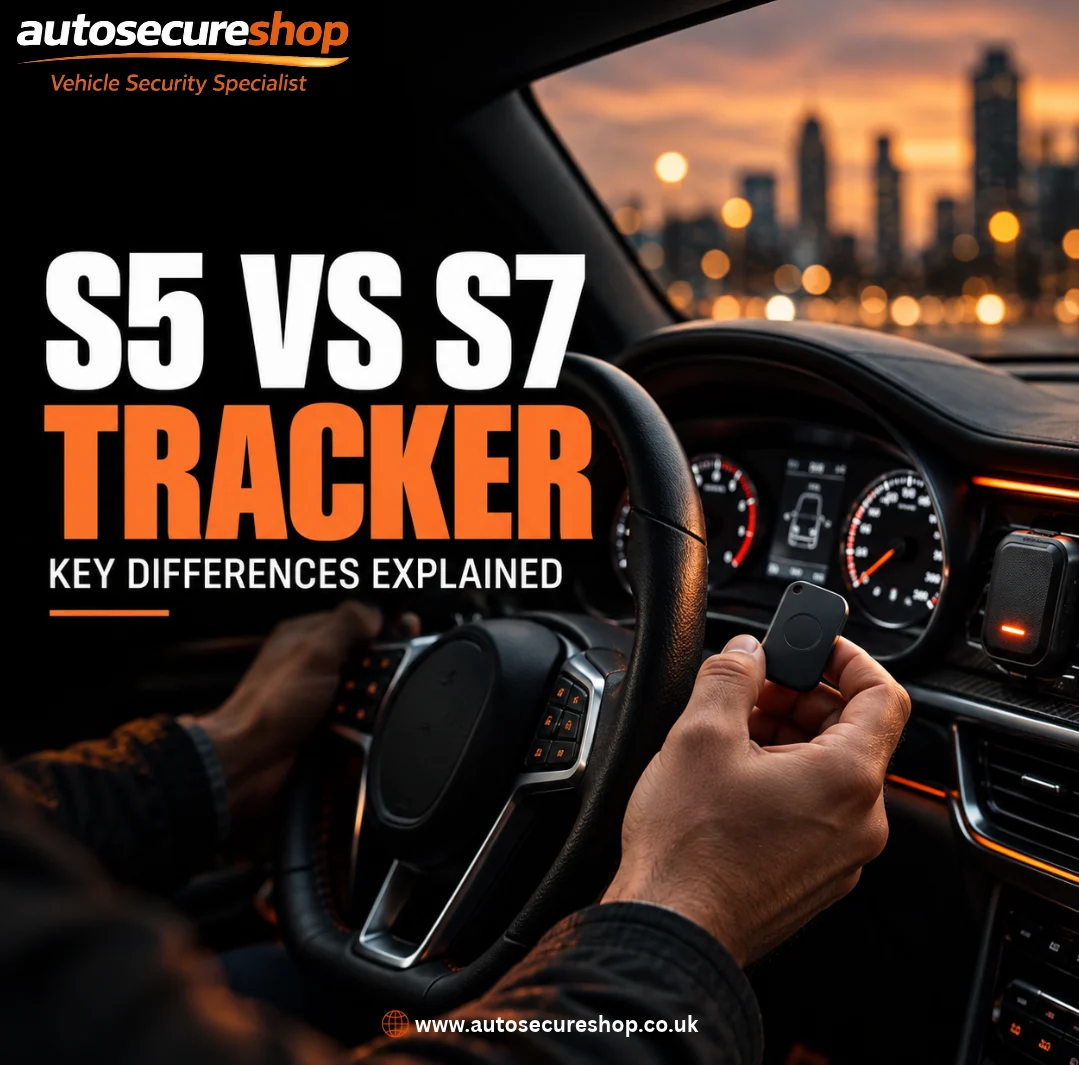
Most of the s5 vs s7 tracker confusion comes down to one feature: automatic driver recognition, or ADR. Both categories are Thatcham approved, both are monitored around the clock and both exist to help get a stolen vehicle back. The tracker reports the vehicle’s location to a control centre, and that centre contacts the owner and supports recovery if something looks wrong. Where the two part company is in how they spot a theft. An S5 adds a small driver tag that the tracker looks for whenever the vehicle is started. If the tag is missing, the monitoring centre treats the journey as suspect. An S7 has no tag, so it relies on movement and tamper alerts instead.
Which one a vehicle needs is usually decided by the insurer rather than personal preference. Some policies name S5, some accept S7 and some ask only for a Thatcham-approved tracker, so the wording on the policy matters more than the badge on the box. The S7 is usually the cheaper of the two, which makes the choice a balance between price and how early a theft is flagged.
Thatcham Research is the body, funded by the motor insurance industry, that tests and certifies vehicle security devices in the UK. Since January 2019 it has approved trackers in two categories, S5 and S7, which replaced the older Category 5, 6 and 7 labels.
For anyone wondering about the s5 tracker meaning: a Thatcham S5 tracker is a monitored stolen vehicle tracking system that includes automatic driver recognition. An S7 tracker is a monitored tracking and recovery system without it. “Monitored” means a certified control centre, open 24 hours a day, receives the alerts and contacts the owner, rather than leaving the owner to watch an app.
An S7 reports the vehicle’s location to a monitoring centre that runs 24 hours a day. It also has motion detection, tamper alerts and an internal backup battery, so it keeps reporting if the main battery is disconnected. If the vehicle is moved without the ignition being used, on a recovery truck for example, or the unit is interfered with, the centre contacts the owner.
The weakness is simple. An S7 tracker has no automatic way of telling the owner from a thief who has a key. A cloned or relayed key starts the engine like the real one, so recovery typically begins once the owner reports the vehicle missing.
An S5 tracker does everything an S7 does and adds the driver tag, which the authorised driver carries. If the vehicle is started and the tag is not recognised, the system raises an alert straight away and the monitoring centre calls the owner. Relay and cloning attacks work by making the vehicle accept a signal that looks like the genuine key, so the vehicle’s own systems see nothing wrong. A thief with a copied or relayed key still has no tag, which is why an S5 suits keyless vehicles and others at risk of key theft.
One caution: the S5 label does not by itself mean the tracker can immobilise the engine. Some products add that, others do not, so the specification of the exact model is worth checking.
Side by side, the two share most of their features. Both are Thatcham approved, both are watched by a monitoring centre around the clock and both raise movement and tamper alerts. Only the S5 has the driver tag and the alert when the vehicle is started without it. The S7 leaves that out, which is why it usually costs less.
Before 2019, trackers were sorted into Category 5, 6 and 7. Old Category 5 devices became S5. Category 6 devices that had driver recognition also moved to S5, while those without it became S7. Category 7 became S7 as well.
In practice, a “Cat 6” tracker in older paperwork is usually the S7 equivalent unless it came with a driver tag. Anyone holding a policy or tracker documents that still use the old names should ask the insurer which current category it treats as the match.
S7 is a Thatcham category. TASSA, the Tracking and Aftermarket Security System Association, is a separate body set up in 2018 by VSST Ltd. It verifies aftermarket security products, services and installers, and it does not define tracker categories. A search for “tassa s7” therefore tends to combine two things: the tracker standard and the scheme that checks who fits it. When choosing a fitter, it makes sense to ask about both.
The tag is a small device carried by the authorised driver. The tracker looks for it whenever the vehicle is started, and a missing tag triggers an alert to the monitoring centre. Keeping the tag apart from the car key means a thief who takes the key still does not have it.
Both categories rely on a 24/7 monitoring service, and that service carries an ongoing subscription. Before buying, ask what the plan covers, how long the term runs and whether the tracker can move to another vehicle. A lower unit price does not always mean lower ownership costs once the subscription is added up over several years.
Ask which category the policy names, whether S5 or S7 is acceptable if it names neither, and whether a tracker is a condition of cover or only earns a discount. Ask what proof of fitting is required and whether the insurer must be told once the tracker is installed. Get the answers in writing.
Thatcham approval applies to the device, but the tracker only protects a vehicle if it is installed properly and reporting to the monitoring centre. After fitting, check that the unit has been tested and registered. Keep the installation paperwork, since the insurer may ask to see it.
In the s5 vs s7 tracker decision, the insurer sets the requirement. Policies differ: some name S5, some accept S7, and some ask only for a Thatcham-approved tracker. If the policy says S5, an S7 will not meet it. If it says S7, an S5 goes beyond the requirement, although the insurer should confirm that in writing.
With no stated requirement, the risk decides. For a keyless vehicle, or any vehicle where key cloning is a genuine worry, the S5 is the more sensible buy, because a copied key is exactly what the tag is there to expose. A lower-value vehicle can be well served by an S7 at a lower price, provided the insurer accepts it. Paying for an S5 only because it carries the higher label makes little sense when the insurer asks for an S7 and key theft is not the main worry.
A tracker does not guarantee a premium discount. If savings are the reason for fitting one, get a quote before and after. Everything here reflects Thatcham and insurer guidance as of October 2026. Standards, insurer requirements and any related UK rules can change at any time, so check the current position before buying.
Both categories need professional fitting. The unit is concealed, powered from the vehicle and set up with the monitoring service, and an S5 also has its tag paired. Both come with an ongoing monitoring subscription, paid after installation. Autosecureshop supplies S5 and S7 trackers with installation included, so the category can be matched to the insurer’s wording before anything is booked.
A tracker only helps if it matches what the insurer asks for and what the vehicle actually faces. A keyless vehicle at risk of relay or cloning attacks gets more from the driver tag on an S5, while an S7 can cover a vehicle where the insurer accepts it and key theft is less of a worry. Check the policy wording first, confirm the category in writing, then have the tracker professionally fitted so the approval means something. Autosecureshop supplies and fits both S5 and S7 trackers, with installation included.
Contact us today Call-0121 330 0145 / sales@autosecureshop.co.uk. To read reviews, CLICK HERE.
The difference is automatic driver recognition. Both are Thatcham approved and monitored 24/7, but an S5 adds a driver tag and raises an alert if the vehicle is started without it. An S7 tracks the vehicle and supports recovery without checking who is driving.
Cat 5 and Cat 6 are older Thatcham labels, replaced in January 2019. Cat 5 trackers became S5. Cat 6 trackers with a driver tag also became S5, while those without one became S7. Category 7 devices became S7 as well, so S5 and S7 are the only two tracker categories now.
It depends on the policy. Some insurers ask for an S5, others accept an S7 and some only require a Thatcham-approved tracker. An S7 will not satisfy a policy that names S5, so confirm the requirement with the insurer in writing before booking any fitting.
No. S7 is a Thatcham Research tracker category. TASSA, the Tracking and Aftermarket Security System Association, is a separate scheme that verifies aftermarket security products, services and installers. The two cover different things and are not interchangeable.
No. A tracker is mainly a recovery tool. An S5 alerts the monitoring centre quickly when the vehicle starts without its tag, but it will not necessarily stop the vehicle moving. A separate immobiliser adds the prevention side, so the two work well together.

£540.00

£898.00 £798.00
We use essential cookies to keep our website working properly. With your permission, we also use optional cookies to understand how visitors use our website and improve your experience.
You can accept or reject optional cookies at any time. For more information, please read our Privacy Policy. Privacy Policy