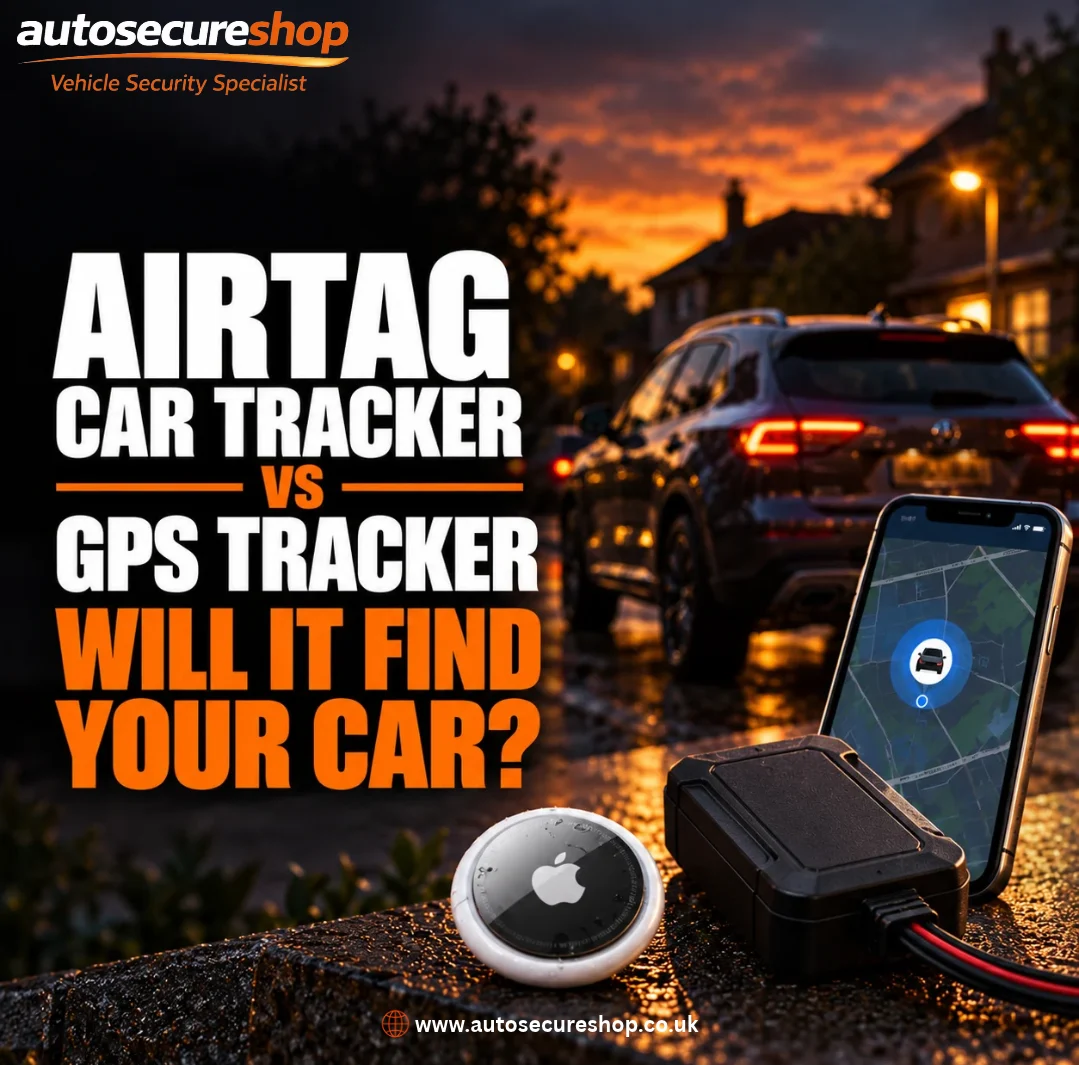
An AirTag can sometimes help locate a stolen car, but it cannot be relied on to. It has no GPS and no mobile connection of its own. A position appears only when an iPhone or another Apple device passes close enough to pick up its Bluetooth signal and relay it. A GPS tracker with its own SIM and a monitoring centre behind it does not wait for a stranger’s phone to walk past. That difference decides almost everything below.
An AirTag car tracker is an Apple AirTag, a coin-sized Bluetooth tag, left in a vehicle so its owner can look for it in the Find My app. The tag sends out an encrypted Bluetooth signal. Nearby Apple devices pass it on, and the owner sees the last reported position on a map.
A replaceable coin battery powers it, and Apple says it should last about a year. Apple built AirTag to keep track of belongings such as keys and bags, not people or pets.
Partly. The signal is short range, and a car body does not help it. On a busy street with plenty of passing phones, the tag may report often. On a rural road, inside a locked unit or in an underground car park, there may be no Apple device close enough to hear it, and nothing tells the owner that the reports have stopped.
It does work sometimes. In June 2025 a London couple used a hidden AirTag to find their stolen car about nine minutes from home, passed the location to the Metropolitan Police, then went to collect it themselves, according to BBC News. Sheffield North West’s neighbourhood policing team has also publicly encouraged drivers to consider a low-cost tracker after a stolen car was found within about 40 minutes.
The second half of the London story is the part to be wary of. Collecting a stolen car without police support is risky, and police advice is to report the theft and leave the recovery to officers. A location is only useful when someone equipped to act on it does so.
Yes, and the design of the system makes that likely. AirTag’s anti-stalking protections exist to warn anyone travelling with a tag that is not theirs. An iPhone shows an “AirTag Found Moving With You” alert when a tag separated from its owner keeps moving with it, and Android 6.0 and later has its own unknown tracker alerts. A separated tag also makes a sound when it is moved.
Most thieves carry a phone. If an alert appears, the tag can be found and thrown out. The London owner said she moved quickly because she feared finding only the tag, discarded on the street, without the car.
A professionally fitted GPS tracker works differently. The installer hides it, it makes no sound, and it does not trigger phone alerts for whoever is driving. Thieves may still go looking for one, and no hiding place is perfect, which is why a tracker should not be the only protection on a car.
Apple launched a second-generation AirTag on 26 January 2026. It has a newer Ultra Wideband chip that lets Precision Finding work from up to 50% farther away, an upgraded Bluetooth chip for longer range and a speaker Apple says is 50% louder.
Thatcham Research certifies tracking under two categories. S5 combines stolen vehicle tracking with automatic driver recognition, and some S5 systems add an immobilisation relay, often sold as S5 Plus. S7 covers monitored tracking and recovery without driver recognition.
S7 is generally the minimum an insurer is likely to ask for, though some policies and higher-value vehicles call for S5. The policy wording decides.
The Crime and Policing Act 2026 creates two offences covering the possession, importation, making, adapting and supplying of electronic devices, such as signal jammers, for use in vehicle theft. The government factsheet gives a maximum penalty of five years in prison, an unlimited fine, or both.
This is based on current data, and the UK government can change the rules at any time. The offence does not stop a jammer working, so a tracker still needs an immobiliser beside it.
Call 999 if the theft is happening or the thief is nearby, and 101 otherwise. Give the registration number, a screenshot of the tracker location with the time it was recorded, and a description of the vehicle.
An AirTag position may be minutes or hours old, so say so. Leave the recovery to the police, because a thief who is cornered can be dangerous.
Set side by side, the two are doing different jobs. An AirTag finds the car by borrowing Bluetooth coverage from nearby Apple devices, so it can only tell the owner where it was last heard. A Thatcham-approved GPS tracker works out its own position using GPS and reports it over the mobile network, whether or not anyone happens to be walking past.
The bigger gap is who is watching. With an AirTag, nobody is. The owner has to open the app, notice the car has gone and decide what to do, because there is no movement alert built in. A tracker of the approved type is monitored by a control centre 24 hours a day, and the alarm is raised when the car moves without authorisation.
Power, fitting and cost differ too. An AirTag runs on a coin battery that lasts about a year, and the owner can leave it wherever they like, with no ongoing charge. A GPS tracker is fed by the vehicle’s own electrics with a backup battery, is fitted by an installer and usually comes with a monthly subscription. The AirTag is cheaper to run mainly because it does less.
Insurers that require a tracker normally name a Thatcham category, usually S5 or S7. An AirTag is not certified under either, so it will not meet a policy condition asking for one. Requirements differ between insurers and vehicles, so the policy wording, or a call to the insurer, settles it before anything is bought.
A tracker reports where a stolen car is. It does not stop the car being taken, and it can be interfered with. Thatcham Research says signal jammers are used to hide a vehicle’s location after a theft. The Home Office counted 132,412 thefts of a motor vehicle recorded by police in England and Wales in the year ending September 2024, and the Metropolitan Police estimates electronic devices are used in roughly 60% of vehicle thefts in London.
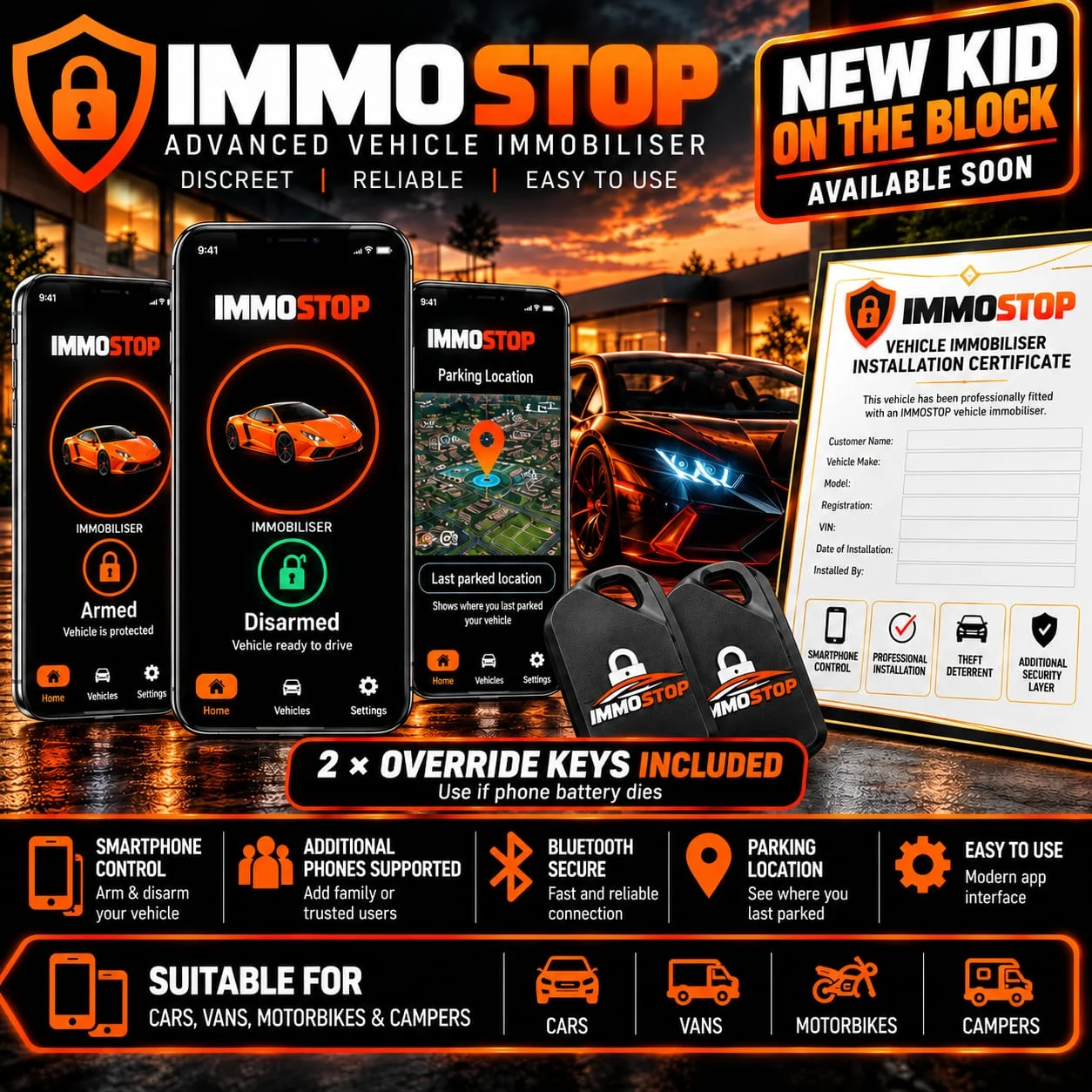
So the sensible set-up has layers: a monitored tracker to find the car and a CAN-bus immobiliser to make starting it harder in the first place. Autosecureshop supplies and professionally fits both, along with alarms and dash cams.
As an extra layer, it is a reasonable idea. A hidden tag needs no installation, costs far less than a monitored system and might give police a lead before a thief’s phone gives the game away. That makes it an easy addition on a second car. It should not be the only protection on a car that is expensive, frequently targeted or covered by an insurer’s tracker condition.
This article is based on current information as of October 2026. Laws, regulations and insurer requirements can be changed at any time by the UK government or the insurer concerned, so treat it as general guidance, not legal or insurance advice.
Contact us today Call-0121 330 0145 / sales@autosecureshop.co.uk. To read reviews, CLICK HERE.
Sometimes. An AirTag has no GPS, so it reports a position only when an Apple device passes close enough to relay its Bluetooth signal. That can work well on busy streets. In quiet areas or enclosed units it may not, and nobody monitors it on your behalf.
Yes. An iPhone shows an AirTag Found Moving With You alert, Android 6.0 and later has unknown tracker alerts, and a separated AirTag makes a sound when moved. A thief who notices any of these can search the car, find the tag and simply throw it away.
An AirTag relies on Bluetooth relayed by nearby Apple devices and is watched only by its owner. A Thatcham-approved GPS tracker uses GPS and the mobile network, is fitted into the vehicle and is monitored round the clock. It usually carries a monthly subscription.
Almost certainly not. Insurers that require a tracker normally name a Thatcham category, such as S5 or S7, and an AirTag is not a Thatcham-certified product. Check your policy wording or ask your insurer which category it accepts before you buy anything.
It does no harm as an extra layer, as long as it is not your only protection. A hidden AirTag may add a lead, but a monitored tracker and a CAN-bus immobiliser do the heavy lifting. If your insurer requires a tracker, confirm the accepted category first.
£549.00
£559.00
We use essential cookies to keep our website working properly. With your permission, we also use optional cookies to understand how visitors use our website and improve your experience.
You can accept or reject optional cookies at any time. For more information, please read our Privacy Policy. Privacy Policy