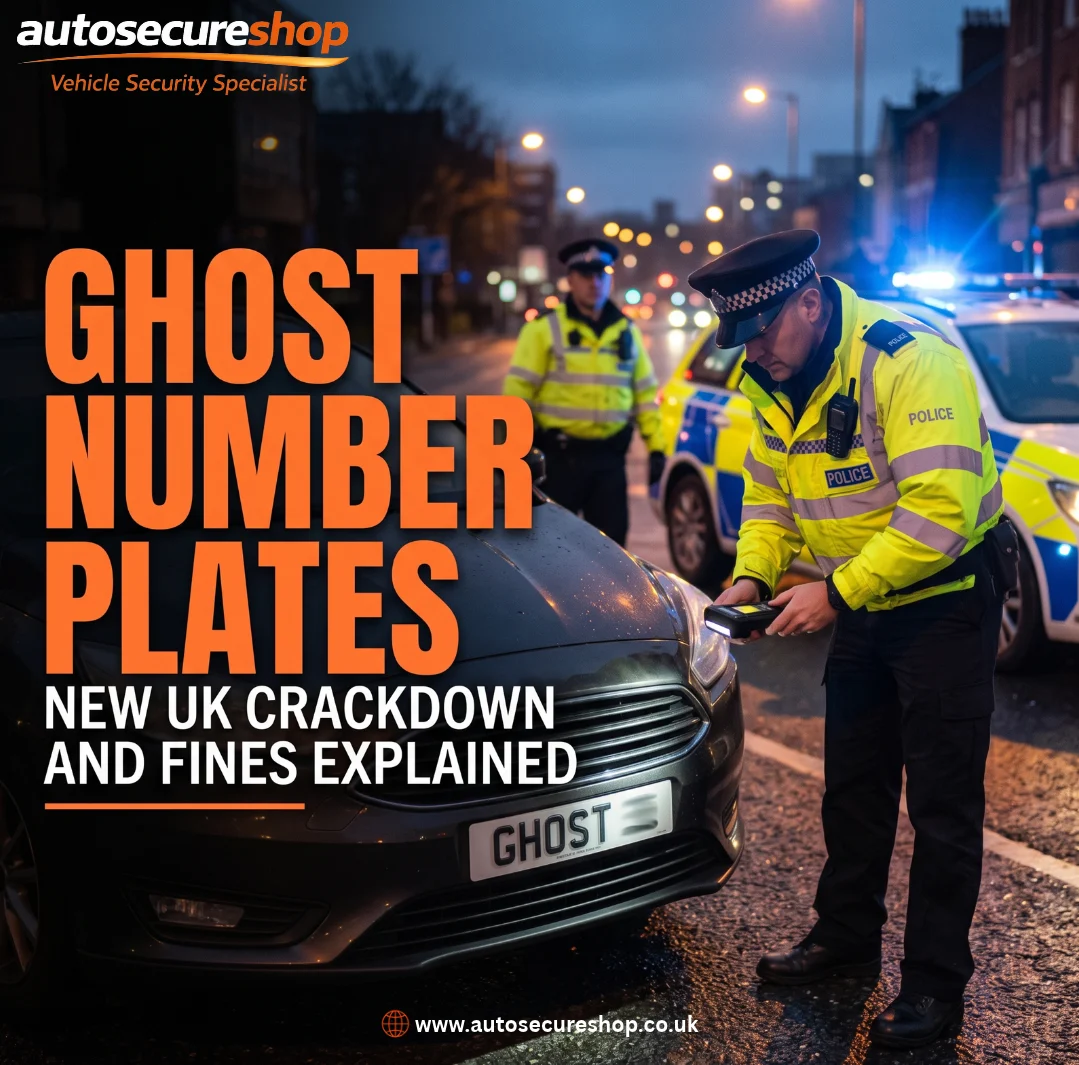
Ghost number plates are registration plates that look normal to anyone standing beside the car but can’t be read properly by the infrared cameras used for speed, ANPR and clean air zone enforcement. They are already illegal in the UK. A driver with an incorrectly displayed plate can be fined up to £1,000, and the vehicle will fail its MOT. What has changed in 2026 is the effort going into catching them: a government-funded police coordination centre in England, trials of new detection kit, and a consultation that could bring penalty points and vehicle seizure.
For most law-abiding drivers, the bigger worry is the other side of the same trade. The sellers who supply camera-proof plates also feed the market for cloned number plates, and a cloned plate means someone else’s speeding tickets and parking charges landing on your doormat.
A legal UK plate is made from retroreflective material to British Standard BS AU 145e. That material bounces infrared light straight back at the camera, so the black characters stand out sharply. Ghost plates interfere with that. The government describes them as plates where a transparent film makes the registration undetectable to cameras. Others rely on raised characters made from materials that read badly under infrared, and the West Midlands Police and Crime Commissioner’s office says ghost plates are typically 3D gel or 4D raised-character plates built from non-compliant materials.
In daylight, to the human eye, nothing looks wrong. To the camera, characters can blur or disappear altogether. The Chartered Trading Standards Institute (CTSI) has warned that they can be bought online for as little as £30, which goes a long way to explaining how the problem spread.
A ghost plate hides a registration. A cloned plate copies a real one belonging to another, legitimate vehicle. With a ghost plate the camera reads nothing useful. With a clone it reads your number perfectly, and the penalty goes to you. Criminals use both, sometimes on the same car, to move around without leaving a usable trail.
On 5 September 2026 the Department for Transport announced funding for the National Roads Policing Coordination Centre (NRPCC), which brings police forces across England together to share intelligence and data on illegal plates. Part of that work is trialling technology, including specialised goggles that can pick out plates altered to defeat cameras. The DVLA and DVSA are supporting investigations into businesses that supply illegal plates and helping with roadside operations.
The government’s reasoning is worth reading closely. It points out that vehicles hidden from number plate recognition are harder for police to find when they are stolen or linked to organised crime. This was never only about dodged speeding fines.
Fines deter people who expect to be caught, so the more interesting changes are aimed at sellers. The DVLA sits on the British Standards Institution committee reviewing BS AU 145e, and the proposed amendments include requiring finished plates to be flat, which targets raised and ghost-style characters. The DVLA has also said it is considering a more robust, auditable process for the Register of Number Plate Suppliers. Done properly, that will probably achieve more than any number of roadside operations.
Under the current rules, a driver stopped with an illegal plate typically receives a £100 fixed penalty notice. If the case goes to court, the fine can reach £1,000. No penalty points apply at present. The car will also fail its MOT, and an insurer may take a dim view of plates that break the law, so check your policy wording if you have any doubt about the plates on your car.
The Road Safety Strategy, published on 7 January 2026, came with a consultation on motoring penalties. One question was whether being in charge of a vehicle with an incorrect, altered or false number plate should carry penalty points and vehicle seizure. That consultation closed on 11 May 2026. Campaigners, including West Bromwich MP Sarah Coombes and the West Midlands Police and Crime Commissioner, have pushed for a £1,000 fixed penalty and six points. For anyone within two years of passing their test, six points would mean losing their licence.
At the time of writing, the government had not published its final decision. This article reflects the rules and proposals in place in October 2026. The UK government can change them at any time, and nothing here should be treated as legal or insurance advice.
Number plates are checked at the MOT, but the check is visual. A ghost plate is designed to look normal to the human eye, so a car can pass while its plates remain unreadable to infrared cameras. A new MOT certificate is not proof that aftermarket plates are legal.
Plates fitted after 1 September 2021 should show the supplier’s mark and BS AU 145e. If either is missing, or the face of the plate has a film or tint over it, replace the plates.
Legal plates must be made by a business on the DVLA’s Register of Number Plate Suppliers. The supplier has to see proof of your identity and your right to use the registration, such as the V5C, and keep a record of the sale. That check is what makes cloning harder.
A seller happy to post plates for any registration without asking for documents is a warning sign. That is exactly the part of the trade the crackdown is aimed at.
A cloned car can carry the clean history of the genuine vehicle it copies, so a registration check alone won’t expose it. Compare the VIN on the car with the one on the V5C, then look up the free MOT history on GOV.UK. Mileages or test dates that don’t fit the car in front of you deserve hard questions.
Ask to see the full V5C, not a photo of part of it. If the car is later traced as stolen, it can be returned to its rightful owner or their insurer, leaving the buyer out of pocket.
A plate doesn’t need deliberate tampering to be illegal. Mud, snow or road grime that makes the registration hard to read can count as an offence, and tinted plate covers are not allowed. A bike rack or towed trailer that hides the rear plate creates the same problem unless it carries its own legal plate.
Wiping both plates after a wet or wintry drive takes seconds. Treat it as part of the same routine as checking your lights.
The first sign is usually post: a speeding notice, parking charge or clean air zone penalty from somewhere you’ve never been. Look closely at any photos supplied with it. A different model, colour or plate style is strong evidence that your registration has been copied.
GOV.UK sets out the process:
1. Report it to the police. In England and Wales, use the cloned number plates form on the police website or call 101. If you use the form, the police pass the details to the DVLA for you. You need to be the registered keeper or have their permission.
2. Write to the DVLA if you didn’t use the police form. It will send a confirmation letter to the address on your V5C.
3. Contact every organisation that has sent you a fine or charge. Tell them you’ve reported the cloning to the police and DVLA, and send your evidence. They decide whether to cancel it, so keep to the deadlines on each notice while you wait.
4. Tell your insurer, even if you aren’t making a claim.
Police may still stop your car if your registration has been flagged, so keep the report reference number and your V5C details to hand.
If your plates are physically stolen rather than copied, report it to the police as a theft and get a crime reference number, because stolen plates can end up on another vehicle. Replacement plates must come from a registered supplier, who will ask for ID and proof that you’re entitled to the registration, such as your V5C. GOV.UK also notes that theft-resistant plates are available, which make it harder for someone to remove a plate quickly and reuse it.
No device can stop someone copying your registration. That depends on suppliers, regulation and enforcement. Security equipment does help with the two problems that sit either side of plate crime: getting a stolen car back, and proving where your own car actually was.
GPS trackers report a vehicle’s real position, whatever plate it happens to be wearing. A stolen car fitted with ghost or cloned plates may slip past ANPR cameras, but a working tracker still shows where it is. Journey history can also help when a cloned-plate fine arrives, because it records where your car was at the time. Whether the issuer accepts it is up to them, but it adds weight to a police reference number.
Dash cams with time-stamped footage do a similar job, while immobilisers and alarms deal with the theft itself. Fitting matters as much as the hardware. A tracker concealed by a professional installer is far harder for a thief to find and disable than one tucked behind the glovebox. Some insurers also ask for a particular standard of tracker or immobiliser, so check with yours before choosing a system.
Your vehicle’s registration plate is more than just a legal requirement. It helps authorities identify your car and ensures that fines and enforcement notices reach the right person. With ghost number plates and cloned registrations under greater scrutiny in the UK, using compliant number plates and checking for signs of cloning is more important than ever. Make sure your plates meet UK regulations, stay alert to suspicious fines or penalty notices, and keep your vehicle registration details up to date. Taking these precautions today can help you avoid unnecessary penalties and protect yourself from the consequences of number plate fraud.
Contact us today Call-0121 330 0145 / sales@autosecureshop.co.uk. To read reviews, CLICK HERE.
Ghost number plates use films, coatings or non-compliant raised characters so infrared cameras can’t read them. In September 2026 the government funded a national police coordination centre in England to target them, and it has consulted on adding penalty points and vehicle seizure.
Drivers with an illegal or incorrectly displayed number plate usually face a £100 fixed penalty, rising to as much as £1,000 if the case goes to court. The vehicle will also fail its MOT. Penalty points don’t currently apply, though the government has consulted on adding them.
Raised 3D or 4D characters are currently allowed if the plate fully meets BS AU 145e, uses a single shade of black and carries the supplier’s mark. Plates made with materials that cameras can’t read are illegal. Proposed changes to the British Standard would require flat plates.
Report it to the police using the cloned number plates form or 101, then write to the DVLA if the police form wasn’t used. Contact every organisation that sent you a fine, quote your reference number and send evidence. Let your insurer know as well, even without a claim.
Yes. A GPS tracker reports the vehicle’s actual location, so changing or disguising the number plate does not hide it. Journey history can also show where your car was when a disputed fine was issued. Professional fitting makes a tracker harder for thieves to find and disable.

£420.00

£559.00
We use essential cookies to keep our website working properly. With your permission, we also use optional cookies to understand how visitors use our website and improve your experience.
You can accept or reject optional cookies at any time. For more information, please read our Privacy Policy. Privacy Policy