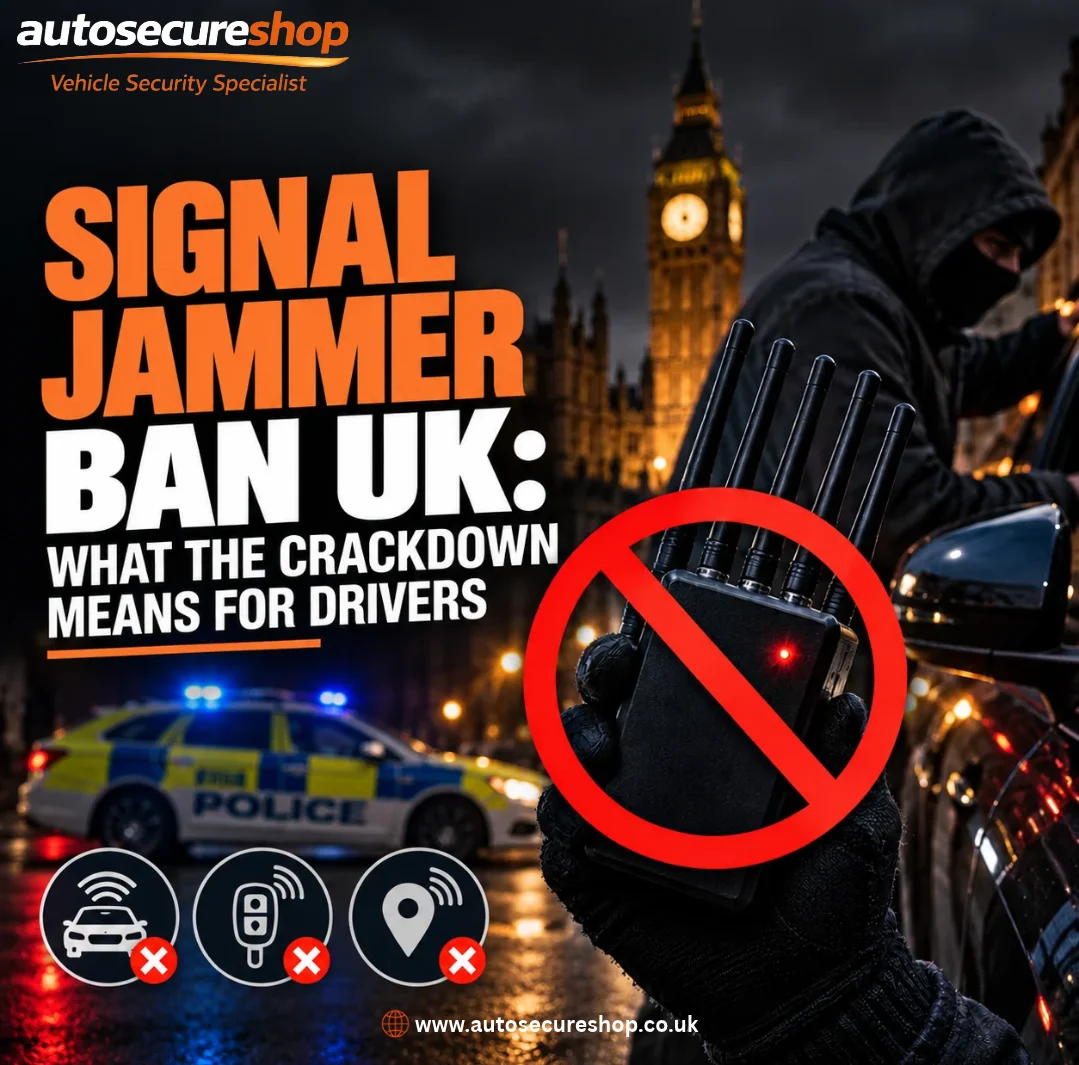
The Crime and Policing Act 2026, which received Royal Assent on 29 April 2026, makes it a criminal offence to possess or supply an electronic device in circumstances suggesting it will be used to steal a vehicle or something inside one. The maximum penalty is five years in prison, an unlimited fine, or both. That is the signal jammer ban UK drivers have been reading about. Separately, the Department for Science, Innovation and Technology (DSIT) ran a call for evidence in spring 2026 on whether owning any radiofrequency jammer should be outlawed.
For the average driver, the law changes less than the headlines suggest. People who steal cars for a living already break the law every night, and one more possible charge won’t stop most of them. What the Act does is make it far easier for police to take the kit off the street. What happens on your driveway at 2am still depends largely on you.
Two quite different tools get lumped together as “signal jammers”.
A car key jammer drowns out the frequency your remote fob uses. You press lock and walk off, but the car never receives the command. The thief waits until you’re inside the shop, then opens the door. Nothing is forced, so there may be no obvious sign of entry.
A relay device, often called a keyless repeater, does the opposite. It picks up the signal from a keyless fob sitting inside your house and passes it to an accomplice standing beside the car. The car believes the key is next to it, unlocks, and in many cases starts.
Thatcham Research also lists key emulators and CAN bus injection tools among the devices the Act targets. Those attack the car’s own electronics rather than the fob.
Section 149 of the Act creates two offences. The first is possessing an electronic device where there is reasonable suspicion it will be used for vehicle theft, theft from a vehicle, or taking a vehicle without authority. The second covers importing, making, adapting, supplying or offering to supply one in the same circumstances.
The real shift is who has to explain themselves. According to the Home Office, these devices were not illegal to own in themselves, and prosecutors had to prove an intention to steal. Under the new offence, it is a defence for the accused to show they did not intend or suspect the device would be used for vehicle crime. Police can seize equipment before any car goes missing.
The government kept the definition of “electronic device” deliberately broad, so tools invented next year are still caught. Ofcom-approved mobile phone signal repeaters, the kind people fit at home to improve reception, remain legal.
Section 149 was not in force on the day of Royal Assent. It takes effect through commencement regulations, so check legislation.gov.uk for the date it applies. This article is based on current published information, and the government can change the law, or how it is enforced, at any time. Nothing here is legal advice.
The 2022/23 Crime Survey for England and Wales found an offender had manipulated a remote locking signal in 40% of vehicle thefts. The Metropolitan Police estimates electronic devices are used in around 60% of vehicle theft in London. Even so, someone stopped with a relay kit in the boot and no stolen car nearby was difficult to charge.
The keyless repeater ban sits in crime law and is tied to vehicle offences. DSIT’s call for evidence, which opened on 10 April 2026 and closed on 8 May 2026, looked at radiofrequency jammers in general.
The Wireless Telegraphy Act 2006 already bans using or possessing non-compliant radio equipment. DSIT’s problem is evidence: proving that a particular person used a jammer to cause interference is hard. The call for evidence asked about the harm jammers cause, whether current enforcement deters anyone, and whether the rules on possession need changing. It also asked about legitimate uses, such as blocking contraband phones in prisons.
Van owners should pay attention to one of DSIT’s examples. It described jammers disguised as everyday objects being used to bypass vehicle security and strip vans of tools. Jammers can also interfere with satellite positioning, which matters if a tracker is part of your security. The responses will feed into any future legislation, so none of it is law yet.
If your fob stops working in a car park and someone is hanging around nearby, don’t leave the car. Lock it manually if you can, or drive somewhere else. Call 999 if a theft is happening now, or 101 to report suspicious behaviour afterwards, giving the time, place and any description.
A dash cam recording or a timestamped photo can help officers link the report to other incidents in the same area.
A relay attack doesn’t care which fob it reaches. A spare keyless fob left in a kitchen drawer near the front door is as useful to a thief as the one in your pocket.
Put every keyless fob in a signal-blocking pouch or tin, not just the one you use daily. When buying a used car, check how many keys it should come with and ask where any missing ones went.
The metallic lining in a cheap pouch can crack after months of folding and stuffing into pockets. Once that happens, the fob may still reach the car while looking perfectly safe.
Test the pouch every few weeks. Seal the fob inside, stand next to the car and try the door handle or start button. If the car responds, replace the pouch.
Jammers can interfere with GPS and mobile signals as well as key fobs, which is why DSIT is looking at radiofrequency jammers more widely. A tracker that simply goes quiet during a theft is far less useful.
When choosing a tracker, ask the installer whether it can raise an alert when its signals are being blocked, and where the unit will be hidden. Placement affects how quickly a thief can find and disable it.
Banning a gadget doesn’t remove it from circulation. These devices are small and easy to hide, and some thieves will simply accept the extra risk. The ban will help most with disruption: a car stopped at night, a device found in the glovebox, and officers with clear grounds to act.
That is useful, but it does nothing for your car tonight.
A jammer only works if you walk away assuming the car locked. The best defence costs nothing.
1. Watch and listen every time. Most cars flash the indicators, fold the mirrors or sound a chirp when they lock. If none of that happens, assume the car is open.
2. Try the handle. On some keyless cars the handle will unlock again if the fob is close, so check your handbook for how your model behaves.
3. Treat a sudden fob failure in a car park as a warning sign. Lock with the physical key blade if your car has one, or move somewhere else.
4. Keep keyless fobs away from doors and windows, inside a signal-blocking pouch or tin. Test it by standing at the car with the fob inside and trying the door.
5. Find out whether your fob has a sleep or disable mode. Some manufacturers offer one, and the handbook will tell you.
Good habits beat jammers, but nobody is perfect at the end of a long day. Hardware covers the gaps.
A Ghost immobiliser is a CAN-bus immobiliser that needs a PIN or separate authorisation, so a relayed or cloned key signal isn’t enough to drive the car away. A professionally fitted alarm adds an audible deterrent and can alert you to an attempted entry. A dash cam with a parking mode can record whoever approached the car.
A tracker won’t prevent theft, but it can help police find the vehicle afterwards. If your insurer asks for specific security, look for insurance-approved trackers and check the policy wording for the exact Thatcham category it requires, rather than assuming any device will satisfy it.
Fitting matters as much as the product. A unit placed behind an obvious panel, or wired so it can be pulled in seconds, is easy to find and defeat. Professional installation is about hiding the kit well and wiring it properly.
A signal jammer ban is a welcome step, but it won’t stop every thief overnight. Criminals use jammers and relay devices to block key fobs and interfere with GPS and mobile signals. Keeping every keyless fob, including spares, in a tested signal-blocking pouch helps, and a professionally installed tracker that alerts you when its signals are blocked, paired with an advanced immobiliser, gives you far greater confidence that your vehicle stays where you left it. Choosing the right security now makes all the difference, whatever the new rules bring.
Contact us today Call-0121 330 0145 / sales@autosecureshop.co.uk. To read reviews, CLICK HERE.
The Wireless Telegraphy Act 2006 bans using or possessing non-compliant jamming equipment. The Crime and Policing Act 2026 adds an offence of possessing a device where there is reasonable suspicion it will be used for vehicle theft. Rules can change, so check current law.
Under the Crime and Policing Act 2026, possessing or supplying an electronic device for use in vehicle theft carries up to five years in prison, an unlimited fine, or both. The accused can defend themselves by showing they did not intend or suspect criminal use.
No. The government has said Ofcom-approved mobile phone signal repeaters, used to boost weak reception at home or work, remain legal to own and use. The new offences target devices linked to vehicle theft, such as relay kits, car key jammers and key emulators.
Watch for the usual lock confirmation, such as flashing indicators, folding mirrors or a beep. If nothing happens, or the fob suddenly fails in a car park, assume the car is unlocked. Lock it with the key blade if possible, or move the car and try again.
DSIT asked for views on radiofrequency jammers of all kinds, the harm they cause, how well current law deters misuse and whether possession rules should change. It ran from 10 April to 8 May 2026, and its findings will help inform any future legislation.

£799.00

£599.00
We use essential cookies to keep our website working properly. With your permission, we also use optional cookies to understand how visitors use our website and improve your experience.
You can accept or reject optional cookies at any time. For more information, please read our Privacy Policy. Privacy Policy