
Vehicle security guides · Motorbike tracking
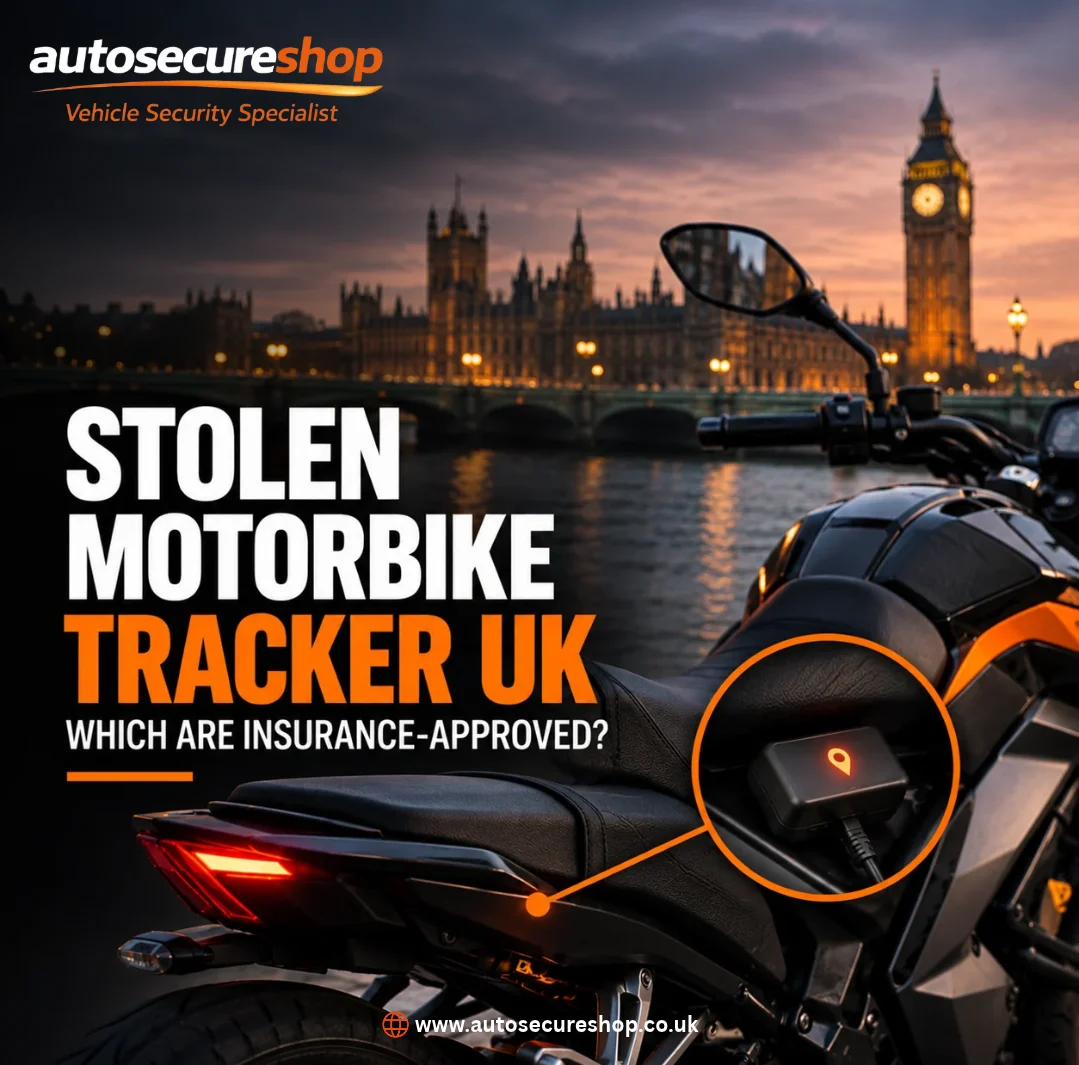
A motorbike tracker counts as insurance-approved when it carries Thatcham Research certification, which for bikes means a device in the S5 or S7 category with a monitoring centre behind it. S5 adds a rider tag that flags unauthorised use. S7 covers tracking and recovery without one. Which of the two an insurer accepts depends on the policy, and the only answer that counts is the one the insurer gives in writing.
Official crime tables lump motorbikes in with other vehicles, so the most useful figure comes from the DVLA. Freedom of Information data published in July 2026 showed 16,585 motorcycle-type vehicles reported to the DVLA as stolen by police between 1 June 2025 and 31 May 2026. That is 3.5% down on the 17,178 recorded a year earlier, and still more than 45 bikes a day. Thefts never reported to police are not in that count, so the real number is higher.
The pattern says more than the total. The ten most-stolen models in that dataset were all lightweight 110cc and 125cc commuter bikes from Honda or Yamaha, led by the Yamaha NMAX 125 with 1,009 thefts and the Honda WW 125 with 620. London recorded 2,603 thefts, more than five times the next city, and Birmingham sat among the next highest with 412.
So motorbike theft in the UK is not just a problem for owners of expensive machines. A cheap commuter bike is light enough to be lifted into a van, and a tracker will not stop that. What it does is give the owner and the police a chance of finding the bike afterwards, which is a different job from a lock.
Thatcham Research, the insurer-backed body that tests vehicle security, certifies tracking devices. Since 1 January 2019 the tracker categories have been S5 and S7. A certified system is monitored around the clock by a control room, which is what separates it from a basic GPS gadget that only shows a dot on a phone.
Certification says nothing about where a unit sits on the bike, and that is how it should stay. A tracker that is easy to find is easy to remove, so reputable fitters do not publish placement and owners should not either.
S7 is the entry level: monitored tracking and recovery, with no driver recognition. S5 includes Automatic Driver Recognition as standard. The rider carries a small tag, and if the bike is started or moved without that tag nearby, an alert goes out straight away. On a bike, where a theft can be over before the owner has noticed anything, that early warning is the strongest argument for S5.
Some policy documents and older tracker listings still use the labels that applied before 2019. Category 5 became S5, while Categories 6 and 7 were largely combined into S7. An insurer asking for a Cat 5 tracker almost certainly means S5, but the wording on the policy schedule should be confirmed rather than assumed.
Insurance-approved trackers depend on a control room that is staffed around the clock, and the subscription pays for it. Without an active subscription the device is little more than hardware in the bike.
Check the subscription terms before fitting, including how it is billed and what cancelling does to the tracker’s status with the insurer.
An S5 tracker only works as intended if the rider carries the tag. A tag kept on the key ring in a pocket does its job. A tag left in the top box or under the seat tells the system the rider is nearby when the bike is being taken.
A lost tag should be reported to the provider straight away, so a replacement can be arranged.
Ask which tracker category the policy accepts, whether a professional installation is required and whether there is a deadline for fitting after the policy starts. Ask what happens to cover if the monitoring subscription lapses, and whether the premium changes once a certified tracker is fitted.
Get the answers in writing, and keep them with the policy documents.
If the insurer names a category, that settles it. Insurers can ask for the higher category on more valuable or more frequently stolen models, so a policy quote is worth reading closely.
Where either is accepted, S5 is the better buy for most riders because the tag triggers the alert at the start of the theft rather than after the bike has gone. S7 usually costs less to buy and to monitor, which makes it a reasonable choice for a lower-value bike, provided the insurer is happy with it.
The Datatool Stealth tracker is a Thatcham S5 device made specifically for motorcycles. It comes with rider ID tags and an owner app, and it adds impact detection that raises an alert if the bike takes a hit. The unit is compact, which counts for a lot on a machine with so little spare room. Autosecureshop supplies and fits the Datatool Stealth S5 stolen motorcycle tracker. Monitoring runs on a subscription that is paid after installation, and the current fitted price and subscription cost are listed on the product page.
For riders comparing options, the Motorbike Trackers category lists the full range. Not every motorbike tracker sold in the UK is Thatcham approved, and a basic GPS unit may help find a stolen bike without satisfying an insurer. The certification line on the product page is the thing to check.
No law requires one. The requirement comes from the insurer, and it can depend on the bike’s value, its model and where it is kept. Some insurers offer a discount instead of making it compulsory.
The distinction matters. A requirement is a condition of the policy, and a bike with no tracker, or with a monitoring subscription that has lapsed, can leave the owner arguing with the insurer after a theft. Ask before buying, and keep the reply.
This guide reflects current information as of November 2026. Insurance requirements, Thatcham categories and government rules can change at any time, and nothing here is legal or insurance advice.
Insurers generally expect an approved fitter, and a unit bought online and fitted at the kitchen table can leave the policy condition unmet. Bikes also leave very little room to work with: a small battery, tight bodywork and wiring that needs to be tidy enough not to drain the battery or flag itself to a thief. Whoever does the job, the owner should leave with proof that it was done.
A tracker is a recovery tool. Locks make theft slower and noisier, which is the whole point of a lock. A ground anchor and a disc lock, with the bike parked out of sight where possible, do more than any app. The range also includes the Datatool Croc-Lock handlebar lock and the Datatool DNA security marking system, which helps identify a bike or its parts if they are recovered.
Before paying for anything, three answers from the insurer are worth having: which category it accepts, who is allowed to fit it, and what happens if the monitoring lapses.
Owning a classic vehicle is about preserving history, passion, and investment. As vehicle theft techniques become increasingly sophisticated, relying on factory-era security is no longer enough. Investing in Classic Car Security UK solutions such as GPS tracking, advanced immobilisers, professional alarm systems, and expert installation provides greater confidence that your prized vehicle remains protected for years to come. Choosing the right security today can make all the difference in safeguarding your classic car tomorrow.
Contact us today Call-0121 330 0145 / sales@autosecureshop.co.uk. To read reviews, CLICK HERE.
No law requires one, but an insurer can make it a policy condition. Insurance-approved means Thatcham-certified in category S5 or S7 with 24/7 monitoring. Ask the insurer which category it accepts, because that wording decides whether a tracker counts.
Both are Thatcham-certified and monitored around the clock. S7 covers tracking and recovery. S5 adds Automatic Driver Recognition, so the rider carries a tag and an alert is raised if the bike moves without it. S7 usually costs less, while S5 reacts sooner.
The Datatool Stealth S5 is certified in Thatcham’s S5 category, the higher of the two tracker levels, and comes with rider tags and an owner app. Insurers set their own rules, so confirm that yours accepts S5 and whether a professional fit is required.
It might. Some insurers discount premiums for a Thatcham-approved tracker, others simply require one for certain bikes, and some do neither. The effect depends on the insurer, the bike and where it is kept, so get a quote with and without the tracker.
A tracker does not physically stop a thief. It alerts the monitoring centre and helps locate the bike so the police can recover it. Pair it with a ground anchor, a disc lock and a secure parking spot to make a theft slower, noisier and harder to pull off.